Showing posts with label IFLA. Show all posts

Sunday, 16 November 2014

Online surveillance and privacy - and libraries?

Three months ago (already? Oops) I attended at the IFLA World Library and Information Congress a session entitled "Mass internet surveillance and privacy - how does it affect you and your library?" It was one of my favourites; so much so that I proposed a session inspired by this topic at Library Camp UK in September.
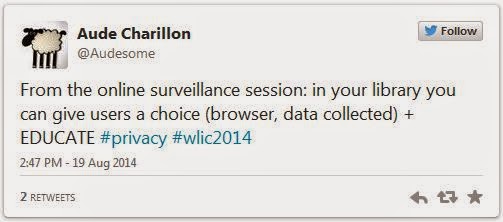

But first, the IFLA debate. It was organised by the Committee on Freedom of Access to Information and Freedom of Expression (FAIFE) and featured a British lecturer in information sciences, a French librarian member of La Quadrature du Net ("non-profit association that defends the rights and freedom of citizens on the Internet"), a representative from Google and another from the Electronic Frontier Foundation (a "non-profit organisation defending civil liberties in the digital world" based in the USA). My notes - mostly live-tweeted - can be viewed in this Storify. It was dead interesting and made me want to explore the questions raised on a more practical level, with other librarians.

And what better place to do this than Library Camp?
Plus, following the OST principles on which unconferences are based, the right people came to the session! Among us were some new to the profession, some more experienced, working across different sectors (public, academic, national library...) and at different responsibility levels. One of the participants wasn't a library person at all, and pushed us to think about our role ("So what are YOU, librarians, going to do about this?") There was even someone who had done a MOOC on cyber-security!

I wanted to know... 1) Is anyone educating their library users on online surveillance and privacy?
Some academic librarians tell the researchers to be careful about what they share online ("etiquette") In information literacy sessions students google themselves as an exercise.
There were comments that sharing a lot of personal information online may be either a sign of naiveness or a shift of culture. The "right to be forgotten" was discussed as well as the fact prospective employers do look you up online.

Online surveillance and privacy session at Library Camp UK 2014
Image courtesy of NLPN
2) Do our libraries offer any tools that help our users stay anonymous online?
Short answer: erm, not so much. It was fascinating to discover that out of the 17 people in the room, only 3 of us had ever used DuckDuckGo ("the search engine that doesn't track you"). In term of browsers on public computers, few libraries offer Firefox alongside Internet Explorer / Chrome - none have Tor!!

Someone made the remark that smartphones are the biggest tracking device. Other "Internet of things" stuff were mentioned, like electricity smart meters.
There is a need for transparency: what are big organisations doing with our data?
When is it ok for our data to be used? Two sides of the coin: technology can be helpful to us and used to our advantage (e.g. when our data is used to make search results more accurate) but unfortunately it is also used for frightening purposes.
Surveillance is not something new: even before modern technology and the Internet there were forms of it - for example opening letters.
'There's been surveillance for - I don't know how long...'
'1984 or so.'
3) Are our libraries just as bad as any other organisation when it comes to tracking their users?
We discussed login requirements for computers and wifi, Internet filters and the browsing history being retained by the IT departments for a certain length of time.
I was astounded to hear a participant explain their council IT team had actually gone against preconceptions and offered - without the library asking - to remove authentication for users accessing the public computer network! (So open-minded IT departments do exist?!)
And the million-pound question of the day, from another participant: "If you were offered a million pound in exchange for your users' data, would you choose to sell your users' privacy to a big company and take the money to save your library?"

And to conclude, one of the key statements made during the session: 
Librarians are here to raise awareness of these issues among their customers to allow them to make their own informed decisions.

Wednesday, 1 October 2014

IFLA Lyon : food for thought

I attended many different sessions at the IFLA World Library and Information Congress 2014; too many for me to write-up my notes! So instead, I am offering you a collectanea (yes, it's a word; look it up!) of the little things that struck me.

Me listening intently at the "Google is not enough" session
CC BY-SA Guillaume Gast (Source: Flickr)


  • Olaf Eigenbrodt (Germany), managed to make an International Standard Organisation technical report sound like a very interesting read. He was talking about ISO/TR 11219:2012 for the planning of library buildings (available on British Standards Online, for those whose library subscribes to it). It contains chapters on how to define different areas of the library, the library as a place for learning / living space, event space, the quality and size of space for collections, space for users, etc.; all chapters reflecting best practice and trends.
  • Are libraries' Acceptable Usage Policy for computer and internet access written in the best way for the user? We should be advising the user - using positive statements and explanations of why something is acceptable - rather than presenting them with a list of things they can't do and citing laws they will never read. Watch out for the Policy development for Acceptable Use in Libraries project in the UK.
Libraries Without Borders' Ideas Box
CC BY-SA Charlotte Henard (Source: Flickr)
    • Users of the National Diet Library (Japan) can access a crazy number (1691) of search guides, created by librarians on very specific topics based on enquiries they have had.
    • When it comes to protect your users' privacy online, there are things you can do in your library: EDUCATE customers, think of how much you yourself filter/watch them and whether it is "necessary and proportionate" and possibly offer them a different browser e.g. Firefox or Tor. [More on the whole online surveillance and privacy in libraries topic in this other blog post]
    • There are people whose job title is "Library Innovation Manager" and sometimes whole teams whose task it is to try out and implement new things! (eg. the National Library Board, Singapore, "Technology and Innovation division")
    • Learning strategies for staff: in many organisations we're not allowed to close the library (anymore) for staff training! Try having 5min each in staff meetings for everyone to share highlights of conferences they have attended or articles they have read.
      Speaker from the National Library Board, Singapore at the "New technologies" session
      CC BY-SA Charlotte Henard (Source: Flickr)

      Just for reference, here are the sessions I attended, with links to the conference programme for more information (including papers when available):

      Sunday, 14 September 2014

      IFLA Lyon : WLIC is that?

      No, I'm not swearing, I promise! The World Library and Information Congress (WLIC) is IFLA's annual conference and the most well-known and of its activities. But IFLA, it's also numerous sections and divisions and strategic programmes and special interest groups... For them, the congress is the opportunity to hold committee meetings and to present their findings and activities, simply because there are so many people attending! And for those who may feel a bit lost in the crowd, there are things like the caucuses and the Newcomers' session.

      CLM Standing Committee meeting
      Most of the groups tend to hold one committee meeting before the start of the congress and one during it. To attend, it's easy: *all* you need to do is walk up to the chair of the group and ask for permission.

      I chose to go (you're not going to be surprised here) to the Copyright and other Legal Matters (CLM) meeting on 16 August, and it was probably the most intimidating thing I did during the congress! But before I continue let me dissipate a misconception: Standing Committees don't hold their meetings while standing up - I checked, they all had chairs. They even had chairs for observers like me actually. There was one other observer in the room: a lady who seemed to know everyone and had been to many IFLA WLIC before. She wasn't very talkative but was still a handy person to be sitting next to when you're not sure of the procedure!
      This committee is composed of these very experienced-looking people (and I don't mean old, I mean confident and obviously knowledgeable; a lot of them heads of libraries) but also affable:


      And, just like at any normal committee meeting, they reported on the group's activity (e.g. participation in WIPO talks) and news, commented on CLM issues affecting libraries, discussed actions and future plans (for example suggestion for topics for WLIC 2015 sessions)...
      They even had a mini impromptu debate on the "right to be forgotten"! It was very interesting to see how the issue was perceived by people of different nationalities, depending on the personal data laws and perception of privacy in their country. Paul Whitney brilliantly summed up the "right to be forgotten" by saying it is "akin to requiring a library to withdraw a catalogue record but not the actual item from the collections".

      UK caucus
      A caucus is for those who feel a tad concussed (see what I did there?) by all this internationalism and need a bit of reassurance that they also have peers from the same country / language / region in the place. Basically it's a gathering of people.

      I went to the UK caucus as I feel more of a "UK librarian" than a "French-speaking librarian" (most of my fellow French volunteers went to the caucus for French-speaking participants) and I do not regret it at all! I think it was the best: instead of being all formal sitting in rows in a room, everyone stayed standing and chatting in the corridor (maybe because that's where the wine and canapés were? Huh.) The speeches lasted no more five minutes each: there was a welcome from CILIP President Barbara Band, from IFLA President-Elect Donna Scheeder and from the CFIBD (French international committee for libraries and information services) President Pascal Sanz.


      Newcomers' session
      Still on the same line of trying to make participants feel less overwhelmed by the whole thing is the newcomers' session . It took place on the Sunday morning before the official opening ceremony. The panel was chaired by Barbara Lison, a member of IFLA's Governing Board, who welcomed six different "IFLA people" and asked them to talk about their first WLIC, what coming to the conference can bring to an attendee, plus their tips for first-timers. Here are some of my favourites:
      • When asked: "How do you become an IFLA President?", Ellen Tise (IFLA President 2009-2011) replied: "Take pictures of yourself with the current IFLA President!" On a more serious note, she gave the best advice for anyone at a conference: "Don't stay with people from your own country; go and sit next to someone you don't know in a session and introduce yourself" because you are there to meet and learn from others.
      • Ian Yap (Manager for the IFLA Regional Office Asia and Oceania) said that an IFLA conference makes you realise that everyone is facing the same issues. To make the best of WLIC, listen to other's ideas and contribute to the discussion.
      • Jérémy Lachal (IFLA International Leaders Associate) : "IFLA is one of the best antidepressant in the world - it makes you realise that you are not alone."
      • Kent Skov Andreasen (IFLA Governing Board member) said that people who chose to come to IFLA WLIC were open-minded, curious and confused - between so many sessions! You need to take the inspiration and ideas gained from coming to the conference and do something with them.

      Thursday, 11 September 2014

      IFLA Lyon : the volunteer experience

      From 15th to 22nd August I was lucky enough to attend the 80th IFLA World Library and Information Congress in France. The poor inhabitants of Lyon saw 4,000 librarians invade their city for a full week - but they were pre-warned: there were signs everywhere!


      How did I manage to get myself there? Simple: I applied to be a volunteer and was selected (ok, for that to happen, I have to admit that being bilingual French-English was a great help) That meant that in exchange for helping out four half-days I could go to the rest of the congress for free! Brilliant.

      Being a volunteer obviously means attending training (in my case watching the videos and reading up) before the conference and having duties once you're there: arriving a day earlier for the last instructions, being on time for your shifts even if they start at 7am, staying at your post for several hours at a time... But it also meant being part of a big family of people wearing sky-blue gilets (congress participants affectionately nicknamed us "the Smurfs"!) - a family of almost 300 people, a third of whom were staying in the same student residence, a very sociable family whose members organised two very well-attended tours of Lyon or suggested a different bar to meet in every night.

      It was the second time I attended a conference as a volunteer (the first time being the ABF congress in 2012) and I would definitely recommend it. Not only is it a very affordable way to participate in an event of this scale, but being part of such a group makes it more friendly and less intimidating - even if you go without knowing anyone it won't last for long!

      original picture: CC-BY-SA Guillaume Gast
      So yes, there was a good atmosphere at IFLA Lyon; I talked to librarians from France, the UK, Italy, Romania, Canada, the USA, Malaysia, two different central-African countries (but unfortunately I can't remember which ones), Australia, Brazil... People were generally happy to be there and to answer questions about libraries in their countries.
      The Lyon Tourist Office also helped make it a great experience: all congress attendees had free travel on public transport and free entry to most city-centre museums (though personally, the only building I visited was... the hospital's dental emergencies service. Never mind!)

      In the next few posts I will tell you about:
      • what I learnt about IFLA through attending a standing committee meeting, a caucus and the newcomers' session;
      • the little things that struck me from all the different sessions I attended;
      • and hopefully, tell you about a debate I attended which led me to propose a session on a similar topic at Library Camp UK 2014.