Showing posts with label Library Camp. Show all posts

Sunday, 16 November 2014

Online surveillance and privacy - and libraries?

Three months ago (already? Oops) I attended at the IFLA World Library and Information Congress a session entitled "Mass internet surveillance and privacy - how does it affect you and your library?" It was one of my favourites; so much so that I proposed a session inspired by this topic at Library Camp UK in September.
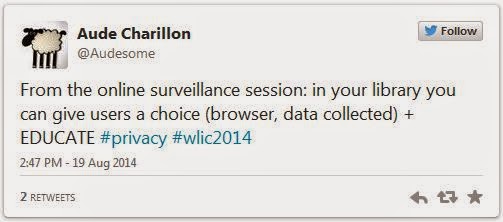

But first, the IFLA debate. It was organised by the Committee on Freedom of Access to Information and Freedom of Expression (FAIFE) and featured a British lecturer in information sciences, a French librarian member of La Quadrature du Net ("non-profit association that defends the rights and freedom of citizens on the Internet"), a representative from Google and another from the Electronic Frontier Foundation (a "non-profit organisation defending civil liberties in the digital world" based in the USA). My notes - mostly live-tweeted - can be viewed in this Storify. It was dead interesting and made me want to explore the questions raised on a more practical level, with other librarians.

And what better place to do this than Library Camp?
Plus, following the OST principles on which unconferences are based, the right people came to the session! Among us were some new to the profession, some more experienced, working across different sectors (public, academic, national library...) and at different responsibility levels. One of the participants wasn't a library person at all, and pushed us to think about our role ("So what are YOU, librarians, going to do about this?") There was even someone who had done a MOOC on cyber-security!

I wanted to know... 1) Is anyone educating their library users on online surveillance and privacy?
Some academic librarians tell the researchers to be careful about what they share online ("etiquette") In information literacy sessions students google themselves as an exercise.
There were comments that sharing a lot of personal information online may be either a sign of naiveness or a shift of culture. The "right to be forgotten" was discussed as well as the fact prospective employers do look you up online.

Online surveillance and privacy session at Library Camp UK 2014
Image courtesy of NLPN
2) Do our libraries offer any tools that help our users stay anonymous online?
Short answer: erm, not so much. It was fascinating to discover that out of the 17 people in the room, only 3 of us had ever used DuckDuckGo ("the search engine that doesn't track you"). In term of browsers on public computers, few libraries offer Firefox alongside Internet Explorer / Chrome - none have Tor!!

Someone made the remark that smartphones are the biggest tracking device. Other "Internet of things" stuff were mentioned, like electricity smart meters.
There is a need for transparency: what are big organisations doing with our data?
When is it ok for our data to be used? Two sides of the coin: technology can be helpful to us and used to our advantage (e.g. when our data is used to make search results more accurate) but unfortunately it is also used for frightening purposes.
Surveillance is not something new: even before modern technology and the Internet there were forms of it - for example opening letters.
'There's been surveillance for - I don't know how long...'
'1984 or so.'
3) Are our libraries just as bad as any other organisation when it comes to tracking their users?
We discussed login requirements for computers and wifi, Internet filters and the browsing history being retained by the IT departments for a certain length of time.
I was astounded to hear a participant explain their council IT team had actually gone against preconceptions and offered - without the library asking - to remove authentication for users accessing the public computer network! (So open-minded IT departments do exist?!)
And the million-pound question of the day, from another participant: "If you were offered a million pound in exchange for your users' data, would you choose to sell your users' privacy to a big company and take the money to save your library?"

And to conclude, one of the key statements made during the session: 
Librarians are here to raise awareness of these issues among their customers to allow them to make their own informed decisions.

Monday, 24 June 2013

Organising Library Camp North East

Library Camp North East took place at Northumbria University on Saturday 15th June 2013. I happen to have co-organised this event - along with Nichola, Louise, Jennie, Isabel and Elaine - and here I'm just sharing my thoughts on the process.

How it came about
The time: September 2012; the place: Newcastle City Library; the occasion: CILIP Big Day.
So there we were, Louise, Jennie, Nic and myself (and a few other people but I can't remember who!) enjoying a drink at the end of the CILIP members' day. Nic was telling us that she was going to Library Camp UK in Birmingham the following month. I was the only person there who'd already been to a Library Camp (the one in Birmingham the previous year, as it happens) so Nic and I were explaining the concept to our interested audience. Such was the interest, actually, that I stupidly said: "Hey, why don't we organise one up here in the North East?" I say "stupidly" only because I was quite busy at that time, and I certainly didn't expect the response I got to this idea, which can be summed up liked this: "YEAH, let's do that! You lead on it and we'll help you." So that's what happened, and I'm really glad we did it.

I put a call out on Twitter later on ("Guys, were you serious about this?"), just to confirm. A few more people expressed interest in helping out, which was lovely. Eventually, Isabel and Elaine joined the organising team.

Venue and refreshments
We needed a venue - preferably free of charge - and we naturally turned to Northumbria University. Northumbria has a Library School and is known for hosting library events such as North-East CILIP workshops and the Mini Umbrella. We know several of the lecturers, so I contacted Biddy Casselden and explained about Library Camp North East. Biddy was very helpful - she got in touch with the dean of the School on our behalf, and we were granted a free room for "library outreach activities".
Knowing how busy universities are in term time, we had planned to hold the event after the students had left. And so it was that Northumbria's Sutherland Great Hall was available on 15th June. The date was set!

What would we have done if we hadn't been lucky enough to be granted this room by Northumbria? We would have asked elsewhere, of course! All six of us work in different organisations, so we would have made enquiries there first, before possibly going to other libraries or considering hiring a room in a private building.

So we had a venue, but we wanted to be able to offer refreshments: at least drinks, maybe lunch. Ideally, we wanted to bring our own fruit juice, tea bags and hot water flasks, especially as Northumbria catering is quite expensive. After several emails and some waiting time, we learned that we would not have access to a kitchen (i.e. nowhere to refill flasks).
At this point, we knew we would get some money from Library Camp UK ("leftovers" from their crowdfunding campaign for their 2012 event), and some from North-East CILIP and the CILIP Career Development Group North-Eastern division (it so happens that 5 out of 6 of the organisers are CDG NE committee members, and the last one's involved with NE CILIP), but we weren't sure exactly how much. Furthermore, we had already discarded the idea of going down the crowdfunding route ourselves.
So we took up the suggestion of offering attendee packs that contained bottled drinks, which turned out quite cheap, and encouraged participants to bring cake and savoury snacks for the day, hoping there would be enough for lunch. In this regard, it worked quite well - a few people did go out for an extra sandwich but most stayed in.

Task allocation
If I had been the one to get the ball rolling originally, from the start I was grateful there was a team of people I could ask for help and advice. It was my first time organising an event on this scale, and it made things a lot less scary to be able to check with others that I was doing the right thing, and to be able to rely on them for all the things I could not do or think of. We were emailing each other back and forth with opinions and suggestions, and everyone volunteered to take on some tasks. I know (because they told me) that some of the team feel like they have only volunteered for smaller tasks and haven't helped that much, but to me that doesn't look like a problem as everything that needed to be done got done by people who were happy to do it.


Advertisement and attendee numbers
We started advertising in February, four months away from the event - I've had people telling me that it was a bit early. We did it then because there were other library camps being organised in other regions, and we wanted our local colleagues to know that there would be one happening on their doorstep!
We sent a reminder email to everyone who had booked a place at the end of May. Quite a few people let us know then that they could not make it anymore, and we were able to offer these tickets to those on the waiting list and even put some "up for grabs". In the end, there was 40 of us on the day, for 60 places advertised.
I do know that there is a natural drop-out for all events (due to people not feeling well on the day and other unexpected situations arising) but to be completely honest, I was slightly disappointed by the turnout considering that the event had been fully booked before the end of March. What happened? Where did we go wrong?

A bit of a conclusion
After all this, I'm happy to announce Library Camp North East was a success. I'm not saying this just because I'm a naturally enthusiastic person, but because a nice number of people came and everyone seemed to enjoy themselves (if you haven't, please get in touch, we'd like to hear your opinion too) and go away with something - and I don't mean cake!
If I was going to do it again, one particular thing I might try to handle differently is knowing how much money we can count on from the start, instead of waiting to appreciate how much we need to ask for.
But I am going to end this - already rather long - post by paraphrasing the four main principles of Open Space Technology, on which unconferences such as Library Camps are based:
  1. Whoever came was the right people
  2. Whenever it started was the right time
  3. Whatever happened was the only thing that could have
  4. When it's over, it's over it's time for a drink