Showing posts with label Carnegie Library Lab. Show all posts

Monday, 5 December 2016

Commons are forever

This article is the write-up of a talk entitled Empowering users about their rights to use creative works I gave at the National Acquisitions Group (NAG) conference on 14 September 2016. This write-up is also to be published in the Winter edition of NAG's journal Taking stock - which is why it's a bit more formal than my usual posts!

Did you know that Selma, the film about an episode of Martin Luther King’s life released in January 2015, does not use his actual speeches? It is because of copyright issues.
Have you ever tried watching a music video on YouTube, and instead it showed you a message: “This video contains content from … who has blocked it on copyright grounds”?

Copyright is everywhere and even celebrities seem to get embroiled in infringement cases – in these conditions, how can we expect library customers and the wider community to know what they can and can’t do with copyrighted works, especially online videos and images?

Copyright criminal by Alec Couros [cropped]
licensed under Creative Commons BY-NC-SA (Source: Flickr)

What role do libraries have to play in this?
Libraries exist to defend people’s right to enrich and improve their own lives, their environment and society. We library and information professionals make this happen by facilitating access to and the sharing of information, knowledge and culture. Therefore we should be helping our customers discover works they have a right to use freely, such as works in the public domain e.g. that belong to them.


The Commons are forever project at Newcastle Libraries
My role at Newcastle Libraries is within the Business & IP Centre. My colleagues and I are certified by the UK Intellectual Property Office to provide inventors and entrepreneurs information on patents, designs, trade marks and of course copyright. I often feel like people leave us feeling a bit scared about using intellectual property (IP), as we have to tell them to be careful when using IP that may belong to others. What I wanted to do is to invert this situation entirely, and instead tell library users: “yes, it's fine, you can use this without fear of infringement”.

What gave me the impetus I needed was the Carnegie UK Trust Library Lab programme, which aims to support innovation and leadership in public libraries. A call for projects was issued in September 2014 and I was lucky enough to be selected as part of the first cohort of Partners. Thanks to the programme I was able to access funding to develop my project and was supported by a mentor – artist and curator Dominic Smith.

The project became known as Commons are forever. It aimed to empower members of the public about their rights to use creative works that are free of copyright, e.g. in the public domain, and to in turn share what they create with others. It took the form of a series of events that ran at Newcastle City Library from April 2015 to Autumn 2016; the events being a mean of engaging citizens in learning about copyright and enabling them to be creative and actually re-use works.

Rebecca Moosavian and Cory Doctorow at Newcastle City Library
Image by Steve Brock under Creative Commons BY-NC (Source: Flickr)

“Discover and re-use creative works at your library”
Commons are forever was launched with a talk entitled "Copying – right or wrong?" with local law lecturer Rebecca Moosavian and author and activist Cory Doctorow. With this event we sought to both attract attention as Cory Doctorow is a well-known science-fiction and young adult writer but also to get people to understand what copyright is and the potential issues with the current system. It was certainly thought-provoking, with Cory Doctorow proposing that copyright on a work last only 12 years (compared with the duration of the life of the author plus 70 years currently!) with the possibility to be renewed but only by the creator.

Other events in the series were developed in collaboration with local digital media artists and focused on remixing public domain or openly-licensed works. There were an “archive cut-and-paste” session using images from the City Library's local history collections; a film remix workshop where participants re-recorded dialogues from public domain films; a live-coding session using sounds that have been published under an open licence... New creative works made by participants during the events were shared via the Newcastle Libraries' Flickr account.

We also ran in both 2015 and 2016 a photography competition called "We Love Monuments!" based on the Wikimedia Foundation's Wiki Loves Monuments but restricted to pictures of listed buildings and monuments within the borders of Newcastle City Council. Participants had to upload their entries to Wikimedia Commons, where all content is either in the public domain or under an open licence. They therefore learned about the licences and discovered Commons as a collaborative repository for such content. The pictures uploaded now contribute to promoting Newcastle's history and heritage on Wikipedia and engaged the community in making a record of the local area.

Old and New Newcastle by Alan Warriner - winner of We Love Monuments! 2015
Published under a Creative Commons BY-SA licence (Source: Wikimedia Commons)

From creative works to open data
Several of the events involved coding or other digital literacy skills – during the project we were able to test out these types of activities which now form part of the legacy of Commons are forever at Newcastle Libraries. Another part of the project's legacy is the work we have been doing around open data. 

Commons are forever was originally focused on re-using creative works: works created by others - the type that in libraries we facilitate access to e.g. books, images... But our library service also collects and creates information and content: we therefore wanted to open these up and get citizens to re-use them as well. 
We published as much of Newcastle Libraries' statistics and data sets that we could under an open licence on the Council's open data pages, and invited members of the community to have a play at our first mini-hackathon – Wuthering Hacks – in April 2016. We continue to work on updating and expanding the data sets we make available, and finding ways to engage our local community in using and re-using the information.

Impact of the overall project
  • 53% of event attendees who filled in a feedback form say the event has improved their understanding of how they can use open licenses and what the public domain is. (40% said they already had a good understanding.)
  • Before the events, 14% of attendees said they felt very confident about using work either in copyright or out of copyright correctly while 25% said they did not feel confident doing so at all. After the event, 36% now felt very confident and the ones who did not at all were 4%.
  • 53% of participants said the event they attended has contributed to improve their image of public libraries (47% already valued public libraries).
  • 86% of event participants strongly agree that the library is a place for the exchange of knowledge and sharing of culture (10% slightly agree). 
  • Through the project we have worked with three local artists, a local lecturer, a local photography group, a local arts and heritage project and the local open data community; none of whom the library service had ever engaged with before.

Mimi and Eunice sketch - Copyleft Nina Paley

Do the same in your library 
I believe opening up library collections and information and empowering citizens about their rights to use and re-use works is part of the mission of libraries and our role as professionals. Libraries should be part of the open movement as we have a similar ethos; librarians should be contributing to open source tools if we can and promote the use of open content, tools and resources to their local community.

To do that might be more of an organisational change: it is not just about empowering library users but about empowering staff, and changing the policies relating to library content to make it “open”.

Another lesson from Commons are forever would be: be cunning in your event planning – organise something fun and creative to teach something as dry as copyright!

And finally: do not be afraid, just try things and see what happens.

Thursday, 14 July 2016

The WHY of libraries and librarians

Funnily enough, in the middle of writing this (which was actually months after finishing the book mentioned further down and starting thinking about it all), I discovered a library consultant had just written a blog post in which he says how important Simon Sinek's concept is for him. So it's not just me, Andy Priestner says it too!!

It starts with the Carnegie Library Lab online learning programme. Tom Forrest made our little group of Carnegie Partners watch a video by Simon Sinek then put into words the WHY, HOW and WHAT of our projects. I'll let you watch the video below so you understand what I'm talking about (it's 18:34 long and totally worth your time, but if you're in a hurry you can go for just the first 6 minutes).


Simon Sinek makes the point that most organisations know WHAT they do and HOW they do it, but not always WHY they do it - the WHY being their purpose, their beliefs, their reasons for doing what they do the way they do it. This WHY is essential as "people don't buy what you do - they buy why you do it"; it is the WHY that inspires people to "buy" into what you do and creates loyalty for your organisation (from both staff and customers). When you communicate you should communicate your WHY first not your WHAT, because your WHY is what people will react to the most. On another level, if you act according to your beliefs (your WHY) in HOW you do things and WHAT you make, it means WHAT you do to achieve your WHY can take many forms but still makes sense, for example branching into different products or services. What you do in your organisation proves what you believe in, what people do by buying into your products or services proves what they believe in.

Ok, that's a very quick summary (you should really watch the full video!) Simon Sinek wrote a whole book about this topic, entitled Start with Why. I don't often read non-fiction books, but this one came warmly recommended by a fellow Carnegie Partner so I stuck my teeth into it (no, no literally! Who do you think I am - I would never do that to a library book); it took me ages but I read it.

And it made me think. (I know, it's unbelievable - right!?)
It made me think about the WHY of libraries, their raison d'être, and people's perceptions of it. And it also made me think about WHY I am a librarian, what it is in me that makes me passionate about the role of libraries.

The WHY of libraries
It's not easy to phrase in a definite way what public libraries are for - in the profession and outside of it everyone has their own variation on the matter. A couple of years ago I was at a debate organised by CILIP North East on volunteer-run libraries; on one side were founders of a volunteer-run library, while on the other were professional librarians. I was struck by the fact the volunteer library people seemed to think a library was about books, whereas the librarians defined the library as being about access to information. I think the librarians' point of view then is representative of our profession: we do not believe libraries are about books - and yet so many of our residents (even those taking our defense), stakeholders, decision-makers think so. Where does this discrepancy come from? Where did we go wrong?

Could we have made the mistake of communicating too much on WHAT we do, rather than on WHY we do it? No wonder some of our customers or stakeholders don't understand why we are introducing digital and making activities in our libraries, if we have made them believe we were mainly about books. No wonder politicians say things like: "Public libraries are outdated; they have been replaced by the Internet" if we have made them believe the wrong thing about libraries' role. No wonder we're struggling for survival, if most people have no clue WHY we're essential to our communities.

In my last job interview - the one where I was actually re-applying for my own post, and if I failed I was being made redundant - I suggested re-writing the library service's vision and mission statement. It was probably a bit of a risky thing to say in those circumstances (!) but I ask you: does your library's vision statement say why the library service exist, what is its raison d'être? Mine doesn't. It jumps straight into the WHAT. It says " we do", "we will", "we have". It doesn't say "we believe in", "we are here for". It looks good but it's not enough: it's not inspiring, it's not going to make anyone think twice about cutting our budget again. Because it doesn't say WHY we do what we do, and it doesn't leave scope for our potential to do other things, to adapt to our customers' needs.

WHY I am a librarian
Now I'm not saying changing the way we talk about our libraries will save us from budget cuts - but if it helps change perceptions, wouldn't it be worth a try? Maybe something like this...
{WHY} * Libraries exist to defend people’s rights to enrich and improve their own lives, their environment and society.
[HOW] Our library staff make this happen by facilitating access to and the sharing of information, knowledge and culture.
[WHAT] We keep our buildings safe and welcoming, we maintain collections for members of the community to consult and borrow, we organise and host learning and social activities.
How's that?


Start with Why also made me think about WHY I am a librarian and why I am now so committed to public libraries it is hard for me to think of leaving them. The answer is easy: I believe in them. I believe in the role of public libraries; public libraries' WHY align with my personal principles and interests. Public libraries defend people's rights; I think if I wasn't working in a public library I might want to work for a civil rights association, or - as one of my friends once suggested to me - for a politician! (I did laugh in his face.)

Thinking about the WHY of libraries and of myself as a librarian has made me change the way I introduce myself and talk about libraries outside of the library sector. In my current role I regularly deliver workshops for entrepreneurs, inventors and established businesses - I always explain that I am an information professional (think Mystique in X-Men : First Class: "Mutant Librarian, and proud") and why I'm the person they need. But it is a stance I am now also using within my own library service, especially with frontline staff: explaining that this is what we stand for, all of us, together; this is why we exist and we do those things.
I have started using what I believe is the WHY of libraries to promote and explain the events I've recently organised - for example the hackathon. Organising a hackathon in a library, using library data released under an open licence makes sense: because libraries' raison d'être is to enable people to improve their circumstances and environment, by sharing information.
I've started using the WHY / HOW / WHAT structure in articles (though not in this one, otherwise it would be less chaotic!) and in presentations - and I should probably use it more.

And what about you?


Try this at home
Take a pen and a piece of paper - or grab your nearest device with a notebook function. And type/write down:
  1. The WHY of your library or information service - why does it exist in the first place, what is its raison d'être? What, as an organisation, does it believe in?
  2. HOW is your organisation achieving this? In what ways does it put its WHY into practice?
  3. WHAT are the kind of things you are actually doing, at the end of the line? WHAT services do you propose to your users?
Then take a breath, jump a few lines, whatever - have a little pause. And continue.
4. WHY are you, personally, in libraries? What is it you believe in that aligns with your organisation's purpose?
Then be ready to shout about it. Be an advocate for what you believe.


Tuesday, 25 August 2015

The ToonLibraryBox : setting up

As mentioned in a previous blog post, as part of my Carnegie Library Lab project Commons are forever one of the ideas was to set up a LibraryBox at Newcastle City Library.  I thought I would share here my experience of doing just that - as a kind of "LibraryBox for the only-mildly-techy people" (like me) heads-up. So it's not an how-to guide but just some notes about stuff I encountered, which are going to make the "people in the know" smile while reassuring the others that they're not alone!

Newcastle Libraries present... the ToonLibraryBox

Set up a - what??
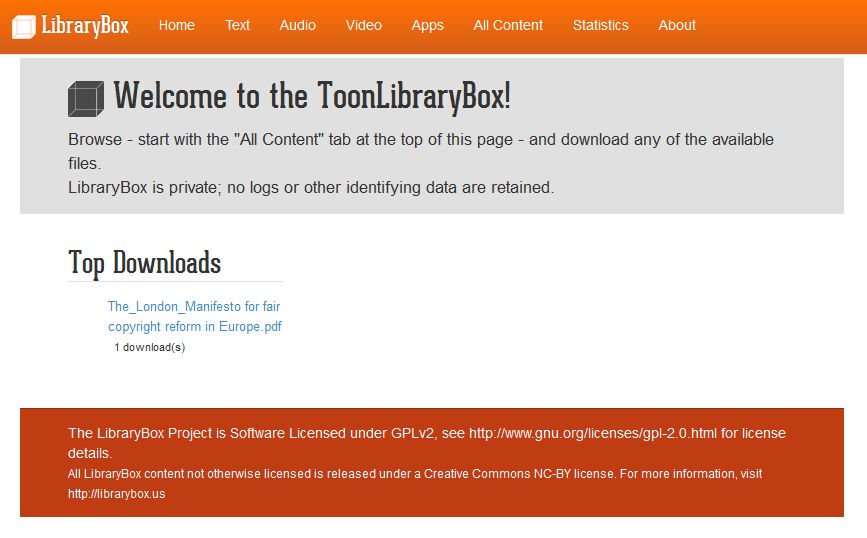
Oh, sorry - you've never heard of LibraryBox? It's a portable digital file distribution tool mainly composed of a router and a USB stick; to use it people just connect to the LibraryBox on a wifi-enabled device, open a browser window and can start downloading whatever documents are stored there. These documents are often either in the public domain or shared under an open license, and obviously carefully chosen by the librarian.
It may not have made it into the Oxford Dictionary yet, but the plural of LibraryBox is LibraryBoxen.
For more information on how it can be used, what you need to do to set up your own and how to customise it, there are two wonderful resources out there: the US LibraryBox Project original website and the French BiblioBox [in, well, French!]
CC BY-NC Jason Griffey (Source: LibraryBox)

What FAT32 really means (or how to nearly fail before even starting)
We are at the beginning of the story set-up. After reading thoroughly the instructions on both websites mentioned above (I am the kind of person who re-reads twice the recipe), I have ordered my MR3020 router and my USB stick. I know I need my USB formatted in FAT32 (whatever that is). I am spending a quiet evening in the library - I crack my knuckles, look up how to format in FAT32 when my work computer runs Windows, and start.
And I wait. And wait. And wait (well, to be honest I did other things in the meantime!) and it doesn't work.
I am the stubborn type. I try again. Error message again: "volume size too big". Erm, what? As it turns out, you can't format in FAT32 something that's bigger than 32GB. My USB (because I'm greedy ambitious) is a 64GB. Oops.

Thankfully, all I need to do is partition the thing to obtain 2 x 32GB to be formatted. But I cannot do that on my work computer because it's all locked and as a librarian I don't have that kind of permissions. Thankfully, I'm friends with the IT guy (more on that later) and he's kind enough to do it for me. Phew! First thing learnt.


Does your library have a predatory wifi network?
At this point, I have managed to set up my LibraryBox. I test it with my phone: it works! It's fantastic. I am so excited I want to show my friend the IT guy. I go over to his desk. Tell him what to do. It doesn't work anymore. *panic*

Sensing my dismay, my IT guy asks: "Oh, so this thing is its own wifi network, right? Have you had it white-listed?" "Erm, why?!", I ask.
Well, ladies and gentlemen, Newcastle City Library has a wifi network - for members of the public to access the Internet of course. But this network cancels out every other wifi network in the building. So when I connected to my LibraryBox, its wifi network had just been born and I managed to use it. But a few minutes after it was too late for my LibraryBox: the library's predatory wifi had noticed it and blocked it!
Needless to say, my friend from IT made the necessary calls to get the LibraryBox network unblocked.
Tip: be nice to your IT people - not only because it's a good thing to do, but also because you're probably going to need them anyway. (Honestly, if my favourite IT guy wasn't diabetic I'd have bought him chocolates)
The ToonLibraryBox homepage


While I was waiting for my LibraryBox to be "allowed" at City Library, I took it home to continue tweaking it. Also I wanted to "play" with Putty and FileZilla - and as you can imagine, it was much easier to do this on my own laptop than asking to get these installed on a work one.

My trusted old laptop did surprise me a bit as it just didn't pick up the LibraryBox, though it does recognise other wifi networks. I had to go in Control Panel / Network and Internet / Network and Sharing Centre / Advanced Sharing Settings - and turn on the network discovery.


The Box goes ever on and on
So now the ToonLibraryBox is set up, what is left to do? Just a couple of "small" things...
  1. Find it a permanent home. There are some great examples of LibraryBoxen being "staged" to make them more visible / tangible in the library, attract customers' attention to it, indicate where the signal is best, etc. I'd like to do something like that. I have a display case, just nowhere to put it! (or, if I'm honest, nowhere I would like it to be) So at the moment, the ToonLibraryBox is hidden somewhere on level 3 of City Library (but it works).
  2. Promote it. It's been in "test phase" for several months - it's now high time to properly launch it and make its presence more widely known to customers (and, yes, staff).
  3. Curate it. Change / add to the content regularly, develop themes, get people (both staff and customers - maybe even artists and authors?) to contribute to it. I have already spoken to my Local Studies colleagues (they have some interesting digitised material) and to the Library's publishing house but I am hoping to get other teams on board too.


I'm also chuffed by the fact the ToonLibraryBox is listed on the "France map of LibraryBoxen" (thanks to the guys over at BiblioBox). I know, claiming on a map of France a LibraryBox located in England - wars were started over that sort of thing!!! But I'm also looking forward to hear from colleagues in the UK (and beyond) interested in LibraryBoxen - so, over to you!

Sunday, 8 March 2015

My Carnegie Library Lab project

Did you know that Selma, the recent film about an episode of Martin Luther King’s life, does not use his actual speeches? It is because of copyright issues.
Have you ever tried watching a music video on YouTube, and instead it showed you a message: “This video contains content from … who has blocked it on copyright grounds”?
Copyright is everywhere - so how do you know what you can and can’t do? Where can you find free works that you can legally use?

CC BY-NC-SA Chris Messina
(Source: Flickr)
From these questions, my answer obviously is: libraries can show you. Libraries are here to share knowledge and facilitate access to information, so we should help people know their rights and discover free content. But how do we do that? How do we attract attention to this problem and the role libraries can play? How do we start changing people's attitudes?
And that's when Carnegie Library Lab came along...

Carnegie Library Lab is a programme of the Carnegie UK Trust which aims to develop leadership and innovation in public libraries. For me, applying was the opportunity to bring together my interest in copyright issues (some of my colleagues would say I'm a bit of a copyright geek!), my belief in the role of libraries, my envy at seeing super cool things happening in France or the US (but not much in the UK) to promote public domain works and users' rights online - and do something with it all.

And then - quite extraordinarily - my project was one of the seven selected (Hehe!) If I'm honest, I'll say that one of my library managers, who did tell me my application was very good, also admitted that they didn't quite expect it to win as my project looked quite... radical!!


Now, there is a lot of work to do to implement it but it is also one of the most exciting things I've worked on! Thankfully, I can rely on colleagues for help and support (poor @biblioluke has been roped into it again) as well as the wonderful Carnegie Library Lab gang - formally known as the Carnegie Partners. As part of the programme, the Carnegie Trust has provided me with a mentor: Dominic Smith, on top of being an artist and digital curator, also has a PhD in open source (how cool is that?!)

The first hurdle for me to overcome was finding the project a proper name. It wasn't easy - finally I picked one that had both a literary reference in it (I have never read any Ian Fleming novel, but his titles are just perfect for parody) and the potential to spark an interesting conversation on the duration of copyright...

So to sum up: Commons are forever is a project developed by Newcastle Libraries with support from the Carnegie UK Trust. It aims to empower members of the public about their rights to use creative works that are free of copyright, i.e. in the public domain, and to in turn share what they create with others.
This will be achieved through a series of events to take place from April 2015 to March 2016. Ideas (to be developed / enhanced / changed / scrapped / revived) so far include: a debate on copying, a “where to find free ebooks” session, a hackday using library data, participation in Wiki Loves Monuments, workshops with local artists and Makers to give attendees the chance to use and re-use expired intellectual property (e.g. library collections in the public domain) and share the new works created under a Creative Commons license via a LibraryBox...
The name's Library. I'll-show-you-where-to-find-copyright-free-stuff Library.
Prepare yourself to hear a lot more about this project on this blog (and elsewhere?) in the year to come!