Showing posts with label France. Show all posts

Tuesday, 25 August 2015

The ToonLibraryBox : setting up

As mentioned in a previous blog post, as part of my Carnegie Library Lab project Commons are forever one of the ideas was to set up a LibraryBox at Newcastle City Library.  I thought I would share here my experience of doing just that - as a kind of "LibraryBox for the only-mildly-techy people" (like me) heads-up. So it's not an how-to guide but just some notes about stuff I encountered, which are going to make the "people in the know" smile while reassuring the others that they're not alone!

Newcastle Libraries present... the ToonLibraryBox

Set up a - what??
Oh, sorry - you've never heard of LibraryBox? It's a portable digital file distribution tool mainly composed of a router and a USB stick; to use it people just connect to the LibraryBox on a wifi-enabled device, open a browser window and can start downloading whatever documents are stored there. These documents are often either in the public domain or shared under an open license, and obviously carefully chosen by the librarian.
It may not have made it into the Oxford Dictionary yet, but the plural of LibraryBox is LibraryBoxen.
For more information on how it can be used, what you need to do to set up your own and how to customise it, there are two wonderful resources out there: the US LibraryBox Project original website and the French BiblioBox [in, well, French!]
CC BY-NC Jason Griffey (Source: LibraryBox)

What FAT32 really means (or how to nearly fail before even starting)
We are at the beginning of the story set-up. After reading thoroughly the instructions on both websites mentioned above (I am the kind of person who re-reads twice the recipe), I have ordered my MR3020 router and my USB stick. I know I need my USB formatted in FAT32 (whatever that is). I am spending a quiet evening in the library - I crack my knuckles, look up how to format in FAT32 when my work computer runs Windows, and start.
And I wait. And wait. And wait (well, to be honest I did other things in the meantime!) and it doesn't work.
I am the stubborn type. I try again. Error message again: "volume size too big". Erm, what? As it turns out, you can't format in FAT32 something that's bigger than 32GB. My USB (because I'm greedy ambitious) is a 64GB. Oops.

Thankfully, all I need to do is partition the thing to obtain 2 x 32GB to be formatted. But I cannot do that on my work computer because it's all locked and as a librarian I don't have that kind of permissions. Thankfully, I'm friends with the IT guy (more on that later) and he's kind enough to do it for me. Phew! First thing learnt.


Does your library have a predatory wifi network?
At this point, I have managed to set up my LibraryBox. I test it with my phone: it works! It's fantastic. I am so excited I want to show my friend the IT guy. I go over to his desk. Tell him what to do. It doesn't work anymore. *panic*

Sensing my dismay, my IT guy asks: "Oh, so this thing is its own wifi network, right? Have you had it white-listed?" "Erm, why?!", I ask.
Well, ladies and gentlemen, Newcastle City Library has a wifi network - for members of the public to access the Internet of course. But this network cancels out every other wifi network in the building. So when I connected to my LibraryBox, its wifi network had just been born and I managed to use it. But a few minutes after it was too late for my LibraryBox: the library's predatory wifi had noticed it and blocked it!
Needless to say, my friend from IT made the necessary calls to get the LibraryBox network unblocked.
Tip: be nice to your IT people - not only because it's a good thing to do, but also because you're probably going to need them anyway. (Honestly, if my favourite IT guy wasn't diabetic I'd have bought him chocolates)
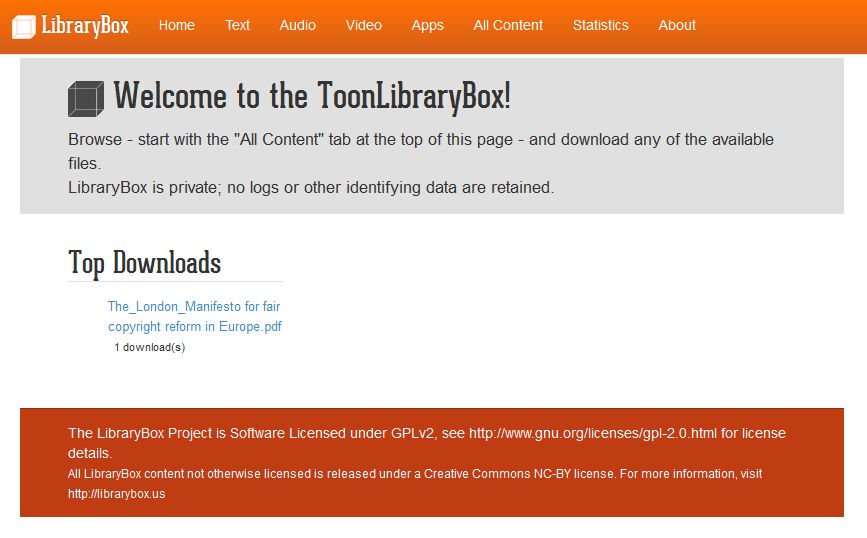
The ToonLibraryBox homepage


While I was waiting for my LibraryBox to be "allowed" at City Library, I took it home to continue tweaking it. Also I wanted to "play" with Putty and FileZilla - and as you can imagine, it was much easier to do this on my own laptop than asking to get these installed on a work one.

My trusted old laptop did surprise me a bit as it just didn't pick up the LibraryBox, though it does recognise other wifi networks. I had to go in Control Panel / Network and Internet / Network and Sharing Centre / Advanced Sharing Settings - and turn on the network discovery.


The Box goes ever on and on
So now the ToonLibraryBox is set up, what is left to do? Just a couple of "small" things...
  1. Find it a permanent home. There are some great examples of LibraryBoxen being "staged" to make them more visible / tangible in the library, attract customers' attention to it, indicate where the signal is best, etc. I'd like to do something like that. I have a display case, just nowhere to put it! (or, if I'm honest, nowhere I would like it to be) So at the moment, the ToonLibraryBox is hidden somewhere on level 3 of City Library (but it works).
  2. Promote it. It's been in "test phase" for several months - it's now high time to properly launch it and make its presence more widely known to customers (and, yes, staff).
  3. Curate it. Change / add to the content regularly, develop themes, get people (both staff and customers - maybe even artists and authors?) to contribute to it. I have already spoken to my Local Studies colleagues (they have some interesting digitised material) and to the Library's publishing house but I am hoping to get other teams on board too.


I'm also chuffed by the fact the ToonLibraryBox is listed on the "France map of LibraryBoxen" (thanks to the guys over at BiblioBox). I know, claiming on a map of France a LibraryBox located in England - wars were started over that sort of thing!!! But I'm also looking forward to hear from colleagues in the UK (and beyond) interested in LibraryBoxen - so, over to you!

Wednesday, 14 January 2015

INPI Keeps Calm and Carries On

This post is inspired by a conversation I've had with @biblioluke, which started with his discovery via The IPKat that someone wanted to register "Je suis Charlie" as a trademark, and ended with us agreeing that "INPI Keeps Calm and Carries On" would just be too good - a blog post title - to miss. So bear with me, I'll explain what happened in between, and add a few thoughts and references.


7th January 2015: attack on freedom of speech at the offices of satirical newspaper Charlie Hebdo in Paris - 12 people killed. As explained in this BBC article, the rallying phrase and logo "Je suis Charlie" was created by Joachim Roncin and quickly adopted by millions of people in France and the rest of the world.

Roncin himself is not claiming any rights over either the phrase or image, saying it belongs to all - i.e. it is in the public domain. The thing with public domain works is that since it belongs to everyone, people are free to also use them in commercial ways. Some tried to gain a commercial advantage by registering the phrase "Je Suis Charlie" as a trademark, which gives a monopoly over the phrase in a particular territory and for particular categories of goods/services. Over 50 applications were received by the French office for industrial property INPI, according to this article by BFM TV [in French]. What interested me in this article is that it said INPI is rejecting those applications on the grounds that the mark is not distinctive (one of the criteria for trademark registration everywhere) since it is largely used by the community, rather than by saying it is immoral or offensive (since another criteria for registration is that the mark cannot be offensive). The IPKat, in the article mentioned at the top, raised the question of whether applications such as these should be rejected on morality grounds, mentioning attempts in the USA to trademark "MH.17" but also "I can't breathe".
Someone in Belgium also applied to register "Je suis Charlie"
as a trademark, before changing their mind

Thankfully, both INPI in France and BOIP in Benelux (see picture above) say they will reject any attempts at trademarking "Je suis Charlie". So really: INPI Kept Calm and Carried On.

Hey, wait a minute! Keep Calm and Carry On - that's also in the public domain, right? In theory, yes: it was created by the British government and "published" (though in a rather confidential way) in 1939 according to this article on the topic, so the Crown copyright on it had long expired (it's 50 years for published works, 125 for non-published ones) when the poster was re-discovered by booksellers in Alnwick, Northumberland. The owners of Barter Books were happy for others to re-use the poster too and everyone was making money from it until... they were stopped because one of their competitors had managed to get an EU-wide trademark over the phrase (the article really is worth reading) But how did that happen when so many people were using it? Surely that meant that, just like "Je suis Charlie", "Keep calm and carry on" is not distinctive?


So if you can't trust your IP office to grant registration to the right kind of stuff, what do you do?
Unfortunately for you, I have recently been reading this very interesting article by Lionel Maurel [in French] which features among other things the Defensive Patent License - basically: you patent stuff so trolls can't have them and you make the patents available to use to a group of people who share your ethos. So before my brains (or yours, if you've had to put the aforementioned article through Google Translate and are now trying to make sense of the result) completely turn to mush, I'd like to ask two more questions: is registration really the best way to protect something from abuse even though it is something that could have belonged to the public domain? Following the examples of "Je suis Charlie" and "Keep calm and carry on", how do you make it work in the field of trademarks? The ALS Association tried to defensively trademark "Ice-bucket challenge" - erm, it didn't work out well for them.

Further reading:
Ledesma, R. (2015). Some Idiot Will Probably Try to Trademark #JeSuisCharlie. It Won't Work. [online] WIRED. Available at: http://www.wired.com/2015/01/do-not-trademark-je-suis-charlie/ [Accessed 14 Jan. 2015].

Tuesday, 23 December 2014

French libraries and the digital world (2/2)

On 13th November I attended a day of workshops on libraries in the digital world organised by the local groups of the French library association ABF at the Marguerite Duras library in Paris. In the first post I talked about the format of the day and the first session I attended (LibraryBox); here are notes and thoughts from the other two sessions.

CC BY-NC-ND Julien (Source: Flickr)
Supporting library users in the digital world
This session was led by Christophe Avdjian and Christelle Moreau of the - under-construction - Françoise Sagan public library in Paris. It was the session I attended that day that had the most participation (maybe because the others were about things that are still so "new", few participants had experience to share?) and it was great to hear everyone chip in with slightly different practices.

The issues we discussed were:
  • What are the skills required to support our library users in the digital world? Most people had learned on the job.
  • Is this activity part of your job description? For some yes, for others not specifically.
  • Should it be every library staff's job or a dedicated team's? The answer seems to depend on the size of the library.
  • What type of workshops (themes) do you offer? Depends if staff know how to use a particular electronic tool/device, if the library buys it for its users... Sparked a discussion on when is it not the job of the librarian anymore, e.g. when it comes to CV writing workshops: it transpired that it is the librarian's job when there isn't any other support structure in the area.
  • What format? (in terms of length of session, group/individual) Some participants also do "on the go"/floor walking-type of support: they go around the library with a tablet to show the electronic resources to customers using the building.
  • Disclaimers: if we install something on the user's device we have a responsibility. It is good practice to specify to the user at the point of booking what they are going to get from the session, and also what they are not going to get.

FabLabs and libraries
I wrote FabLabs AND libraries - not to be confused with FabLabs IN libraries. If I say "FabLab", you will be picturing 3D printers, computers, maybe a soldering station and a laser cutter [and possibly bearded men, but you'd be slipping into a cliché there]. Yes, they are a space for makers to access machines and tools but the opportunity for people to meet in person, exchange on their individual projects and share skills is just as important.


But back to the session: it was led by Julien Devriendt of Choisy le Roi public library and based on the presentation above (tip for non-French speakers: you can start on slide 9 and persevere to the examples and resources).
You might not want to have a FabLab in your library (really) but you can still offer digital fabrication activities.
To have a 3D printer in your library, you would need space, money - possibly extractor fans, and a good health and safety assessment. It might be best to focus on other types of activities, ones that help your users discover and question these technologies, gain new skills... It would be easier to rely on a network of people who know about these things - for example local Makers - rather than expect the librarians to do it. Libraries are about sharing knowledge and are instrumental in creating an environment where people do precisely that.

Ideas for activities:
  • Introduction to coding / programming using free resources like Scratch or Game Salad. Some libraries organise "coding goûters" [the goûter in French is the typical after-school / end of afternoon sweet snack or snack time for children] for families to come and play. Each participant develops their own project, shows it off to the others and receives suggestions for improvement from everyone.
  • Robotics project: support a group of young people taking part in a robotics competition. What strategy to adopt for the robot, what design, how to document the process and share it with others (writing a blog including sketches and description)... Offers the possibility to link with other topics.
  • Stick to simple projects, for example using Makey Makey which apparently is quite easy to use to create interactive "stuff" in your library [I have seen a fruit piano done like this at Gateshead Libraries eDay - it was brilliant] You can find instructions on Make It @ Your Library or Instructables.
ABF has a special interest group devoted to FabLabs - their wiki [in French of course] is worth a visit.


So that's France - but what's happening in the UK? There was a great article in the November 2014 issue of CILIP Update featuring Fab Lab Devon at Exeter Library (the first FabLab within a UK public library), Gateshead Libraries (our neighbours from across the river!), the amazing Sue Lawson of Manchester Libraries talking about working with her local "MadLab", and the intriguing library-hackspace The Waiting Room in Colchester.

And more local to me: where in the country does the annual Maker Faire UK take place? In Newcastle upon Tyne. How far from my workplace did I have to travel to take the above picture of the Newcastle Makerspace? Oh, I just stood on the pavement outside the City Library. What are Newcastle Libraries doing in terms of engaging users with digital fabrication activities? Erm... So what are we waiting for?! ;-)
(Alright, personally I'm now waiting to see what's in the box sent by Common Libraries and looking forward to attending their event at ours in March!)

If you read French (or aren't afraid of automatic translators), the organisers of the workshops have been publishing summaries of each of the sessions on the blog of ABF Paris (all the articles with #ateliersnum in the title)

Sunday, 21 December 2014

French libraries and the digital world (1/2)

On 13th November I attended in Paris a day of workshops on libraries in the digital world organised by the local groups of the French library association ABF. The format of the day was inspired by the unconference principles but it was a lot more prepared than the Library Camps I have attended or helped improvise! Participants were asked for session themes about two months in advance; the programme of the day was settled by the end of September and the organisers appealed to some local librarians with knowledge of the topics to lead the sessions. I was told that since the workshops were taking place on a week day, library managers wanted to see the programme in advance to make sure it was worth them releasing their staff to attend.

Before I tell you about the sessions I attended, I would like to point out something that struck me: both in the UK and France, librarians look to the US - simply because there are so many things happening, so many new developments, ideas that are tested there first - but we tend not to look much to our neighbours on the other side of the Channel. Now, of course we can't compete with the number of interesting projects taking place in the US, but I get the impression that in the UK we don't talk about French libraries - unless a Shakespeare First Folio is discovered in one of them; and when French librarians talk about the UK it's mainly to the shocked at the situation of our public libraries.

"Parisian church..." CC BY-NC-SA JH Images.co.uk
Source: Flickr

LibraryBox
A LibraryBox is a "portable digital file distribution tool" (more information on the LibraryBox Project website) For a user, it works like this: you switch on the wifi on your laptop / phone / tablet and connect to the LibraryBox network. You open a browser window, choose files and download them. It's as easy as that! Users cannot upload files (only admins can) and it's up to the librarian to curate the contents. An obvious use may be to share works in the public domain or under Creative Commons (CC) licences.

The session was led by Thomas Fourmeux of Aulnay-sous-Bois public library. It covered where to source and how to set up a LibraryBox and included discussions on what to use it for and how to make sure customers actually use it too! Here are a few points:
  • It's not just about e-books: on a LibraryBox you can also share audio (e.g. music), video (films), etc. So it can exist either in parallel to a commercial e-book offer (especially when the platform used is not very flexible) or as the only access point for electronic resources a library service may have.
  • Be careful with the content offered on the LibraryBox: check the works are under a licence that allows this (I was interested to hear that Aulnay Libraries offer items under CC including some for Non-Commercial use, and educate users about what it means) but also that it suits your public (in a public space, children may be accessing the LibraryBox too!)
  • Make sure you offer works in different formats so that users can download them in the right format for their device.
  • The browser interface is coded in html so can be edited and expanded, for example by adding a search box or a wiki.
  • The signal of the LibraryBox is not super strong so it may not be accessible in all corners of the library (and even less when it's a big building).
  • Just like with other online resources, people need to know about it otherwise they won't use it. Consider staging the actual Box in the library e.g. as the centrepiece of a display to attract customers' attention. (It also helps resolve the issue mentioned in the point above as people will know where to go to find the strongest signal.)
  • Customers will also need to be educated on how to technically use the LibraryBox.
If you're curious to see what Aulnay Libraries offer on their LibraryBox, they also store the content on a Dropbox account accessible via their website (see the index of works by author) A session participant was going to use her LibraryBox to tie in with local cultural events, and in particular a music festival - asking artists if they would donate a song for people to download freely via the LibraryBox at the festival's location or in other public places.

The early adopters of the LibraryBox in France have created a network of support to share their expertise and spread the word - the website over at Bibliobox.net [in French, obviously] even includes a map of LibraryBoxes in France!

CC BY-SA Bibliobox.net (screen capture 21/12/14)

I have included a LibraryBox in my Carnegie Library Lab project so I am looking forward to ordering and setting it all up come January...

In the next blog post I will sum up the other two sessions I attended that day: on supporting customers in the digital world, and on fablabs & libraries.

Friday, 22 June 2012

ABF 2012, part 2/4: public participation

From 7th to 9th June 2012, the ABF (Association des Bibliothécaires de France - the French library association) held its 58th annual congress in Montreuil, near Paris. And I was there! I had been invited by a friend on the ABF regional branch committee for the wider-Paris area to help out during the three days. This gave me the opportunity to attend several sessions, most of them directly linked to the conference theme: 
The library, a public matter

The last session of the first day and the first workshop of the second day both focused on how to engage with the public in implementing policies and defining services, with numerous examples.

Dominique Tabah opened the second Thursday afternoon session by talking about her experience at Montreuil libraries. She explained that requests from the public must be collected, identified and analysed with attention, be they from library users or non-users. Those requests can be difficult to satisfy but always deserve an answer on what the library service can and can't do.
How do we collect these customer opinions? Dominique Tabah gave several examples of the work Montreuil does with teenagers. Montreuil libraries have a teenage reading committee that meets once a month to select new books for the teenage collection. This is useful to understand what these readers think and expect of the collection. Occasionally, the young people involved also defend their choices in a public debate in front of other customers. Montreuil also asks of middle school pupils doing their work placement in the libraries to survey their classmates on their perception of the service. On top of this, the work placement pupils are also expected to give to their class a tour of the library.

Next, Anita Beldiman-Moore, from Sciences-Po Paris, talked about collecting data on the use of the service and the opinion of customers in a university library.
Sciences-Po have had "test weeks" when staff record the number of enquiries they get by topic as well as depending on the time and the location. This system showed when were the busiest times for each location, and whether the questions asked actually matched the purpose of the designated enquiry desks. For feedback on the quality of the service, Sciences-Po Library uses focus groups and home-made online surveys. It has also started taking part in the international LibQUAL+ survey, which measures the gap between the minimal and maximal level of service customers hope for with the level they are observing.

Xavier Galaup, from the Haut-Rhin regional library service, focused on the importance for libraries to co-create services and contents with their users. Among the examples he mentioned were Helsinki's Library 10 and its music recording studio, more and more libraries putting historical pictures on Flickr for customers to identify or share related stories, a series of "Our customers have got talent" evenings in a town library in Northern France, Brest's local history wiki, a Belgian library streaming website with music from local bands (whom listeners can vote for), ... and many others. You can view his presentation below - in French, but, erm, with pictures!

The Friday morning workshop offered the opportunity for delegates to share thoughts and practice on whether and how to involve customers in some traditionally "librarian-only" tasks. I am going to set out the questions and some of the comments voiced, and then leave you to think about your own answers, and maybe to share and discuss them! Here are the topics:
  • Weeding: what legitimacy has the librarian to act on a public collection? This can be a problem especially in university libraries. Solutions discussed included informing users before the items are discarded, for example by marking items beforehand so that researchers using them can indicate their disagreement, or making lecturers take part in the weeding process.
  • Delegation of acquisitions: who has the right to decide what to buy for the library collection, and to what extent? This conversation actually ranged from the pressure of public policies/the local authority to the system of packages imposed by some providers of digital resources (only a few resources the library is interested in, but no choice to get them other than pay for the lot). I was surprised no one mentioned supplier selection (I almost did) - maybe it doesn't exist in France?
  • Is classification the last bastion of the librarians, where they are the only ones to decide and they can do whatever they want?
  • The customer as a source of knowledge: should there be a public policy on human knowledge to implement? Example: a living library where actual people are added to the library's catalogue.

Wednesday, 13 June 2012

ABF 2012, part 1/4: public policies

From 7th to 9th June 2012, the ABF (Association des Bibliothécaires de France - the French library association) held its 58th annual congress in Montreuil, near Paris. And I was there! I had been invited by a friend on the ABF regional branch committee for the wider-Paris area to help out during the three days. This gave me the opportunity to attend several sessions, most of them directly linked to the conference theme: 

In the opening session, the representative from Montreuil town council declared that "the library [as] a public matter" was indeed an issue on every librarian's mind nowadays, both in the sense of "the library focused on its public" and "the library as a partner of public services, i.e. of the public authority".
The councillor for Culture from the département (French equivalent to a county) of Seine-Saint-Denis reminded us that the budget reductions decided by the central government was an attack on the autonomy of the local authorities. He went on to add that unfortunately, investing in culture was not mandatory for local authorities, which results in projects in that sector being postponed. However, elected members support reading development, he insisted.
The president of the ABF pointed out that reading - not only of texts, but also of music, films, art - development was a major issue, especially as the gap in access to culture in our society is widening.

The following session, on what is a public policy, felt very much like a university lecture. The speaker defined a public policy as a complex set of social issues pushing various stakeholders from different sectors, including public services, associations and other partners, to pass a number of instruments expected to have an effect on society via a process, a sequence of stages that regulate the actions of the state.

Main conference hall during the opening session
The libraries in public policies session gave the opportunity to elected members from different local levels and to an inspector for libraries from the ministry to share their point of view.
Dominique Voynet, mayor of Montreuil, said that community libraries are places full of life, and sometimes they are the only public facility in a given area. Libraries are first a space dedicated to books, but they are also used for other means: they can be a haven, especially to teenagers, somewhere to work and discover new things.
Jacques Marsaud, director of the conurbation committee of Plaine Commune, explained that the conurbation has authority for reading development. Plaine Commune decided to invest in its libraries and modernise the facilities, which immediately resulted in an increase in the number of members, of items issued and in general use. In his opinion, libraries are places where several public policies come together: those relating to education, culture and integration into society. Indeed, considering the number of nationalities represented by the residents of Plaine Commune, libraries play an important role in social cohesion.
Isabelle This-Saint-Jean is in charge of research and higher education at the regional council of Ile-de-France. For her, libraries, on top of being a living space, are essential to student achievement. Libraries are the research facilities for subjects such as literature, social and human sciences, to be compared to the experimental labs used in scientific research. This is the reason why the Ile-de-France region is supporting university libraries by participating in projects to build new facilities and modernise and equip existing ones. They have also introduced a "student essay award".

To compare with these examples in different local areas, Dominique Arot, from the General Inspection Office for Libraries, gave an overview of libraries in public policies from a national perspective.
In the general opinion, the existence of libraries is threatened by digital resources, budget cuts and, more specifically in France, by the delegation of authority from central to local government and the problem of a large variety of libraries under a variety of authorities.
Public policies for libraries come with several issues:
  • They are either implied or absent: libraries are rarely mentioned even though they exist and fulfil a role. There is a consensus on the usefulness of libraries among the authorities but despite that, libraries are not a priority when it comes to the budget and policies.
  • There is a loss of consistency and resources as too many stakeholders lead their own separate policies which end up competing with each other.
  • The state does not have the monopoly for policies anymore: authority has been delegated to regional councils, European Union policies have to be taken into account and the globalisation of information (for example with the Internet) does not help.
  • Library professionals express themselves strongly [just like CILIP in the last parliamentary election year, the ABF produced in 2012 a manifesto], but we hear less from library customers, even though there is a greater number of them.
What are the objectives of the public policies involving libraries?
  • to contribute to learning and to develop literacy, to help young people falling behind in school;
  • to support research;
  • to promote local heritage;
  • to allow everyone access to culture;
  • to develop civic rights and the sense of being part of the community.
Dominique Arot said that there was a need to prove the efficiency of these policies, as evaluation is currently insufficient. For him, the state bears the responsibility for laws and regulations, interdepartmental cooperation, evaluation, shared tools for all libraries to use, technical control (such as the Inspection Office) and the training of library professionals in order to provide a quality public service.


In my next article, I will tell you about two sessions on engaging the public in implementing policies and defining services. But before that, a little bit of comparison between the situation in the UK and in France.
From what I heard at the conference, I am under the impression that French politicians generally have a good opinion of libraries (though obviously, those invited to speak wouldn't say the opposite in front of a room full of librarians, would they?) which isn't necessarily the case in the UK. But still, libraries in France aren't seen as a priority when defining policies and regulations (copyright exceptions and digital rights, anyone?) nor in planning for the budget - though in that regard it is not as bad as in the UK (yet?) ... What do YOU think?


Friday, 2 March 2012

Copy Party press release

Intellectual property law is slightly different in France and in the UK, but here is an interesting event designed as an awareness campaign for copyright.
The text below is my own quick translation of the press release - please be indulgent! The original text, and more information and links, can be found at: http://blogs.iutlaroche.univ-nantes.fr/copy-party/2012/02/09/communique-presse (in French)

"WHAT IS A COPY-PARTY? It is an event allowing users equipped with scanners, phones or laptops to bring these devices and copy books, CDs and DVDs from library collections!

WHAT ARE THE CONDITIONS TO PARTICIPATE IN A COPY-PARTY?
 - These copies must be for private use only;
 - each person must make their own copies using their own replication devices (camera, mobile phone, etc.);
 - the copies must be made from original documents viewed in a library;
 - the act of copying must not break any technical protection (DRM).

WHAT IS THE AIM OF A COPY-PARTY? Via an act that is symbolic, militant and festive, the aim is to:
 - make users aware of copyright law and the right to a private copy as well as of today's issues related to sharing works;
 - attract attention to the interest and the role of libraries in the diffusion, joint use and access to knowledge in the 21st century;
 - question local and national authorities on the development of criminalization policies of digital practices and on the urgent matter of maintaining a free movement of information within a lawful offer.

WHAT DO YOU NEED TO PARTICIPATE?
A bit of equipment. Your choice of a smartphone equipped with a camera and/or an app allowing you to scan documents, and/or a laptop with a scanner and/or a digital camera, some blank DVDs if you wish to copy DVDs.
And a bit of commitment: when you arrive, you will have to sign a document stating that you are committed to only reuse the product of this copy-party in accordance with copyright law, for your strict personal use.

WHAT IS THE LEGAL FRAMEWORK OF A COPY-PARTY? 100% legal
 - The contracts between libraries and copyright holders, which allow works to be put on public display on the libraries' shelves;
 - the exception for performance within the family circle, set out in paragraph 1 of article L122-5 of the CPI [Intellectual Property law];
 - the new rewrite of paragraph 2 of the same article L122-5 of the CPI on the exception for private copy;
 - the rules and regulations of the library.

WHEN IS THE 1ST COPY-PARTY? On 7th March 2012. At 6pm. At the University Library of La Roche sur Yon (France). A world first, quite simply."

http://bit.ly/copyparty