Wednesday, 14 January 2015

INPI Keeps Calm and Carries On

This post is inspired by a conversation I've had with @biblioluke, which started with his discovery via The IPKat that someone wanted to register "Je suis Charlie" as a trademark, and ended with us agreeing that "INPI Keeps Calm and Carries On" would just be too good - a blog post title - to miss. So bear with me, I'll explain what happened in between, and add a few thoughts and references.


7th January 2015: attack on freedom of speech at the offices of satirical newspaper Charlie Hebdo in Paris - 12 people killed. As explained in this BBC article, the rallying phrase and logo "Je suis Charlie" was created by Joachim Roncin and quickly adopted by millions of people in France and the rest of the world.

Roncin himself is not claiming any rights over either the phrase or image, saying it belongs to all - i.e. it is in the public domain. The thing with public domain works is that since it belongs to everyone, people are free to also use them in commercial ways. Some tried to gain a commercial advantage by registering the phrase "Je Suis Charlie" as a trademark, which gives a monopoly over the phrase in a particular territory and for particular categories of goods/services. Over 50 applications were received by the French office for industrial property INPI, according to this article by BFM TV [in French]. What interested me in this article is that it said INPI is rejecting those applications on the grounds that the mark is not distinctive (one of the criteria for trademark registration everywhere) since it is largely used by the community, rather than by saying it is immoral or offensive (since another criteria for registration is that the mark cannot be offensive). The IPKat, in the article mentioned at the top, raised the question of whether applications such as these should be rejected on morality grounds, mentioning attempts in the USA to trademark "MH.17" but also "I can't breathe".
Someone in Belgium also applied to register "Je suis Charlie"
as a trademark, before changing their mind

Thankfully, both INPI in France and BOIP in Benelux (see picture above) say they will reject any attempts at trademarking "Je suis Charlie". So really: INPI Kept Calm and Carried On.

Hey, wait a minute! Keep Calm and Carry On - that's also in the public domain, right? In theory, yes: it was created by the British government and "published" (though in a rather confidential way) in 1939 according to this article on the topic, so the Crown copyright on it had long expired (it's 50 years for published works, 125 for non-published ones) when the poster was re-discovered by booksellers in Alnwick, Northumberland. The owners of Barter Books were happy for others to re-use the poster too and everyone was making money from it until... they were stopped because one of their competitors had managed to get an EU-wide trademark over the phrase (the article really is worth reading) But how did that happen when so many people were using it? Surely that meant that, just like "Je suis Charlie", "Keep calm and carry on" is not distinctive?


So if you can't trust your IP office to grant registration to the right kind of stuff, what do you do?
Unfortunately for you, I have recently been reading this very interesting article by Lionel Maurel [in French] which features among other things the Defensive Patent License - basically: you patent stuff so trolls can't have them and you make the patents available to use to a group of people who share your ethos. So before my brains (or yours, if you've had to put the aforementioned article through Google Translate and are now trying to make sense of the result) completely turn to mush, I'd like to ask two more questions: is registration really the best way to protect something from abuse even though it is something that could have belonged to the public domain? Following the examples of "Je suis Charlie" and "Keep calm and carry on", how do you make it work in the field of trademarks? The ALS Association tried to defensively trademark "Ice-bucket challenge" - erm, it didn't work out well for them.

Further reading:
Ledesma, R. (2015). Some Idiot Will Probably Try to Trademark #JeSuisCharlie. It Won't Work. [online] WIRED. Available at: http://www.wired.com/2015/01/do-not-trademark-je-suis-charlie/ [Accessed 14 Jan. 2015].

Tuesday, 23 December 2014

French libraries and the digital world (2/2)

On 13th November I attended a day of workshops on libraries in the digital world organised by the local groups of the French library association ABF at the Marguerite Duras library in Paris. In the first post I talked about the format of the day and the first session I attended (LibraryBox); here are notes and thoughts from the other two sessions.

CC BY-NC-ND Julien (Source: Flickr)
Supporting library users in the digital world
This session was led by Christophe Avdjian and Christelle Moreau of the - under-construction - Françoise Sagan public library in Paris. It was the session I attended that day that had the most participation (maybe because the others were about things that are still so "new", few participants had experience to share?) and it was great to hear everyone chip in with slightly different practices.

The issues we discussed were:
  • What are the skills required to support our library users in the digital world? Most people had learned on the job.
  • Is this activity part of your job description? For some yes, for others not specifically.
  • Should it be every library staff's job or a dedicated team's? The answer seems to depend on the size of the library.
  • What type of workshops (themes) do you offer? Depends if staff know how to use a particular electronic tool/device, if the library buys it for its users... Sparked a discussion on when is it not the job of the librarian anymore, e.g. when it comes to CV writing workshops: it transpired that it is the librarian's job when there isn't any other support structure in the area.
  • What format? (in terms of length of session, group/individual) Some participants also do "on the go"/floor walking-type of support: they go around the library with a tablet to show the electronic resources to customers using the building.
  • Disclaimers: if we install something on the user's device we have a responsibility. It is good practice to specify to the user at the point of booking what they are going to get from the session, and also what they are not going to get.

FabLabs and libraries
I wrote FabLabs AND libraries - not to be confused with FabLabs IN libraries. If I say "FabLab", you will be picturing 3D printers, computers, maybe a soldering station and a laser cutter [and possibly bearded men, but you'd be slipping into a cliché there]. Yes, they are a space for makers to access machines and tools but the opportunity for people to meet in person, exchange on their individual projects and share skills is just as important.


But back to the session: it was led by Julien Devriendt of Choisy le Roi public library and based on the presentation above (tip for non-French speakers: you can start on slide 9 and persevere to the examples and resources).
You might not want to have a FabLab in your library (really) but you can still offer digital fabrication activities.
To have a 3D printer in your library, you would need space, money - possibly extractor fans, and a good health and safety assessment. It might be best to focus on other types of activities, ones that help your users discover and question these technologies, gain new skills... It would be easier to rely on a network of people who know about these things - for example local Makers - rather than expect the librarians to do it. Libraries are about sharing knowledge and are instrumental in creating an environment where people do precisely that.

Ideas for activities:
  • Introduction to coding / programming using free resources like Scratch or Game Salad. Some libraries organise "coding goûters" [the goûter in French is the typical after-school / end of afternoon sweet snack or snack time for children] for families to come and play. Each participant develops their own project, shows it off to the others and receives suggestions for improvement from everyone.
  • Robotics project: support a group of young people taking part in a robotics competition. What strategy to adopt for the robot, what design, how to document the process and share it with others (writing a blog including sketches and description)... Offers the possibility to link with other topics.
  • Stick to simple projects, for example using Makey Makey which apparently is quite easy to use to create interactive "stuff" in your library [I have seen a fruit piano done like this at Gateshead Libraries eDay - it was brilliant] You can find instructions on Make It @ Your Library or Instructables.
ABF has a special interest group devoted to FabLabs - their wiki [in French of course] is worth a visit.


So that's France - but what's happening in the UK? There was a great article in the November 2014 issue of CILIP Update featuring Fab Lab Devon at Exeter Library (the first FabLab within a UK public library), Gateshead Libraries (our neighbours from across the river!), the amazing Sue Lawson of Manchester Libraries talking about working with her local "MadLab", and the intriguing library-hackspace The Waiting Room in Colchester.

And more local to me: where in the country does the annual Maker Faire UK take place? In Newcastle upon Tyne. How far from my workplace did I have to travel to take the above picture of the Newcastle Makerspace? Oh, I just stood on the pavement outside the City Library. What are Newcastle Libraries doing in terms of engaging users with digital fabrication activities? Erm... So what are we waiting for?! ;-)
(Alright, personally I'm now waiting to see what's in the box sent by Common Libraries and looking forward to attending their event at ours in March!)

If you read French (or aren't afraid of automatic translators), the organisers of the workshops have been publishing summaries of each of the sessions on the blog of ABF Paris (all the articles with #ateliersnum in the title)

Sunday, 21 December 2014

French libraries and the digital world (1/2)

On 13th November I attended in Paris a day of workshops on libraries in the digital world organised by the local groups of the French library association ABF. The format of the day was inspired by the unconference principles but it was a lot more prepared than the Library Camps I have attended or helped improvise! Participants were asked for session themes about two months in advance; the programme of the day was settled by the end of September and the organisers appealed to some local librarians with knowledge of the topics to lead the sessions. I was told that since the workshops were taking place on a week day, library managers wanted to see the programme in advance to make sure it was worth them releasing their staff to attend.

Before I tell you about the sessions I attended, I would like to point out something that struck me: both in the UK and France, librarians look to the US - simply because there are so many things happening, so many new developments, ideas that are tested there first - but we tend not to look much to our neighbours on the other side of the Channel. Now, of course we can't compete with the number of interesting projects taking place in the US, but I get the impression that in the UK we don't talk about French libraries - unless a Shakespeare First Folio is discovered in one of them; and when French librarians talk about the UK it's mainly to the shocked at the situation of our public libraries.

"Parisian church..." CC BY-NC-SA JH Images.co.uk
Source: Flickr

LibraryBox
A LibraryBox is a "portable digital file distribution tool" (more information on the LibraryBox Project website) For a user, it works like this: you switch on the wifi on your laptop / phone / tablet and connect to the LibraryBox network. You open a browser window, choose files and download them. It's as easy as that! Users cannot upload files (only admins can) and it's up to the librarian to curate the contents. An obvious use may be to share works in the public domain or under Creative Commons (CC) licences.

The session was led by Thomas Fourmeux of Aulnay-sous-Bois public library. It covered where to source and how to set up a LibraryBox and included discussions on what to use it for and how to make sure customers actually use it too! Here are a few points:
  • It's not just about e-books: on a LibraryBox you can also share audio (e.g. music), video (films), etc. So it can exist either in parallel to a commercial e-book offer (especially when the platform used is not very flexible) or as the only access point for electronic resources a library service may have.
  • Be careful with the content offered on the LibraryBox: check the works are under a licence that allows this (I was interested to hear that Aulnay Libraries offer items under CC including some for Non-Commercial use, and educate users about what it means) but also that it suits your public (in a public space, children may be accessing the LibraryBox too!)
  • Make sure you offer works in different formats so that users can download them in the right format for their device.
  • The browser interface is coded in html so can be edited and expanded, for example by adding a search box or a wiki.
  • The signal of the LibraryBox is not super strong so it may not be accessible in all corners of the library (and even less when it's a big building).
  • Just like with other online resources, people need to know about it otherwise they won't use it. Consider staging the actual Box in the library e.g. as the centrepiece of a display to attract customers' attention. (It also helps resolve the issue mentioned in the point above as people will know where to go to find the strongest signal.)
  • Customers will also need to be educated on how to technically use the LibraryBox.
If you're curious to see what Aulnay Libraries offer on their LibraryBox, they also store the content on a Dropbox account accessible via their website (see the index of works by author) A session participant was going to use her LibraryBox to tie in with local cultural events, and in particular a music festival - asking artists if they would donate a song for people to download freely via the LibraryBox at the festival's location or in other public places.

The early adopters of the LibraryBox in France have created a network of support to share their expertise and spread the word - the website over at Bibliobox.net [in French, obviously] even includes a map of LibraryBoxes in France!

CC BY-SA Bibliobox.net (screen capture 21/12/14)

I have included a LibraryBox in my Carnegie Library Lab project so I am looking forward to ordering and setting it all up come January...

In the next blog post I will sum up the other two sessions I attended that day: on supporting customers in the digital world, and on fablabs & libraries.

Sunday, 16 November 2014

Online surveillance and privacy - and libraries?

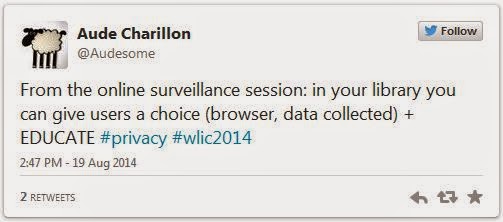
Three months ago (already? Oops) I attended at the IFLA World Library and Information Congress a session entitled "Mass internet surveillance and privacy - how does it affect you and your library?" It was one of my favourites; so much so that I proposed a session inspired by this topic at Library Camp UK in September.


But first, the IFLA debate. It was organised by the Committee on Freedom of Access to Information and Freedom of Expression (FAIFE) and featured a British lecturer in information sciences, a French librarian member of La Quadrature du Net ("non-profit association that defends the rights and freedom of citizens on the Internet"), a representative from Google and another from the Electronic Frontier Foundation (a "non-profit organisation defending civil liberties in the digital world" based in the USA). My notes - mostly live-tweeted - can be viewed in this Storify. It was dead interesting and made me want to explore the questions raised on a more practical level, with other librarians.

And what better place to do this than Library Camp?
Plus, following the OST principles on which unconferences are based, the right people came to the session! Among us were some new to the profession, some more experienced, working across different sectors (public, academic, national library...) and at different responsibility levels. One of the participants wasn't a library person at all, and pushed us to think about our role ("So what are YOU, librarians, going to do about this?") There was even someone who had done a MOOC on cyber-security!

I wanted to know... 1) Is anyone educating their library users on online surveillance and privacy?
Some academic librarians tell the researchers to be careful about what they share online ("etiquette") In information literacy sessions students google themselves as an exercise.
There were comments that sharing a lot of personal information online may be either a sign of naiveness or a shift of culture. The "right to be forgotten" was discussed as well as the fact prospective employers do look you up online.

Online surveillance and privacy session at Library Camp UK 2014
Image courtesy of NLPN
2) Do our libraries offer any tools that help our users stay anonymous online?
Short answer: erm, not so much. It was fascinating to discover that out of the 17 people in the room, only 3 of us had ever used DuckDuckGo ("the search engine that doesn't track you"). In term of browsers on public computers, few libraries offer Firefox alongside Internet Explorer / Chrome - none have Tor!!

Someone made the remark that smartphones are the biggest tracking device. Other "Internet of things" stuff were mentioned, like electricity smart meters.
There is a need for transparency: what are big organisations doing with our data?
When is it ok for our data to be used? Two sides of the coin: technology can be helpful to us and used to our advantage (e.g. when our data is used to make search results more accurate) but unfortunately it is also used for frightening purposes.
Surveillance is not something new: even before modern technology and the Internet there were forms of it - for example opening letters.
'There's been surveillance for - I don't know how long...'
'1984 or so.'
3) Are our libraries just as bad as any other organisation when it comes to tracking their users?
We discussed login requirements for computers and wifi, Internet filters and the browsing history being retained by the IT departments for a certain length of time.
I was astounded to hear a participant explain their council IT team had actually gone against preconceptions and offered - without the library asking - to remove authentication for users accessing the public computer network! (So open-minded IT departments do exist?!)
And the million-pound question of the day, from another participant: "If you were offered a million pound in exchange for your users' data, would you choose to sell your users' privacy to a big company and take the money to save your library?"

And to conclude, one of the key statements made during the session: 
Librarians are here to raise awareness of these issues among their customers to allow them to make their own informed decisions.